Tour review · BERLIN PRIVATE TOURS
Private Taxi Tour City East & West History and Architecture 3-4h
Berlin in one smooth, story-filled drive is the point. This private 3-4 hour East and West history and architecture tour strings together big landmarks, design details, and Cold War clues without wasting your day in transit.
I like the warm or cool taxi comfort paired with lots of short stops, which keeps the pace manageable. I also like that the guide, Gunter Bauer (GAT-Productions), actually gets the timing right, stays fluent in English, and shares both serious history and human details that make the city feel real.
The only drawback is the schedule is tight: you’ll get great context and excellent viewpoints, but you will not have hours inside museums or churches. Think of this as a high-impact highlights tour with smart photo stops, not a slow deep dive.
Key Things You’ll Notice on This Taxi Tour

- Gunter Bauer’s storytelling that connects buildings, politics, and everyday Berlin life.
- East and West in one loop, from Kaiser Wilhelm Memorial Church to Brandenburg Gate and beyond.
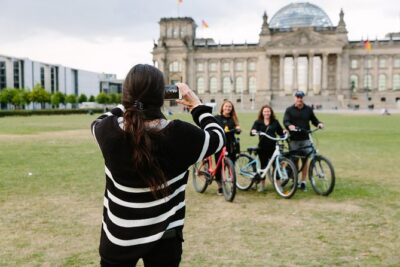
- Iconic stops with quick payoff, like the Kaiser Wilhelm Memorial Church, Reichstag area exteriors, and Gendarmenmarkt.
- Architecture you can spot from the road, including Egon Eiermann’s postwar church designs and Berlin’s “shopping mile” feel on Ku’damm.
- Cold War anchors such as Topography of Terror and a Checkpoint Charlie photo stop.
- Practical comfort with pickup inside the S-Bahn ring and WiFi on board.
Other Berlin days with the guide and route to yourself
- Berlin: Private Reichstag and Glass Dome Tour★ 4.8 · 2,226 reviews
- Berlin Private Complete History All Day Walking Tour★ 5.0 · 474 reviews
- Private Walking Tour Berlin Third Reich Hitler and World War II★ 5.0 · 360 reviews
- Private Berlin: Iconic Sights and Hidden Gems Walking Tour★ 5.0 · 292 reviews
Why This East-West Taxi Loop Works in 3-4 Hours

Berlin is big, and East plus West can turn into a whole planning project. This tour’s strength is that it compresses the main threads: imperial grit, postwar reshaping, Cold War divisions, and the modern city rebuilt on top of it.
You’ll move by taxi with WiFi on board and an air-conditioned vehicle. Pickup within the S-Bahn ring is included, which matters because it removes the “where do we meet” headache and gets you into the sights faster. If you’re staying farther out or coming from BER airport, you can still do it, but it’s an added charge based on Berlin taxi tariff rules.
Price is $150.18 per person for a private vehicle for the group, and that’s where the value gets real. You are paying for time saved, not just sightseeing. When you factor in the taxi time you would otherwise spend hopping across neighborhoods, plus having a guide manage the order of stops, the cost starts to look reasonable, especially for small groups.
This is also a smart choice when the weather is bad. Reviews repeatedly mention that the taxi makes the experience comfortable in winter, with enough stops to look out the window and still keep moving.
The Human Factor: Riding With Gunter Bauer (GAT-Productions)

This tour is at its best when the guide drives the story. Gunter Bauer is the kind of guide who feels like he’s showing you his city, not reading you a brochure.
In the reviews, the themes are consistent: he communicates ahead of time to understand what you want to see, he’s responsive if plans change, and he’s both friendly and efficient on the road. One guest example included rescheduling after a delay, and the tour still ran smoothly the next day. Another mentioned Gunter helping with train tickets after the tour and sending photos later, which is a nice extra if you don’t want to scramble with your camera after you’ve been sightseeing all day.
He’s also described as a great driver and a strong people person for different ages, including late 60s visitors and families with teenagers who might not want nonstop museums. Translation: you’ll get structure, but you’re not trapped in a stiff, timed lecture.
West Berlin Icons: From Zoo Area to Ku’damm Glamour
The western half of Berlin on this route is all about grand boulevards and a careful balance of what survived versus what was rebuilt.
One standout stop is the Kaiser Wilhelm Memorial Church. The point here is not just the postcard tower. You’ll learn why the name is tied to Wilhelm I and the Hohenzollerns, and how the preserved western portal and tower were saved because there was resistance to fully clearing the war-torn site. You’ll also see the “new” parts of the church using modern design based on Egon Eiermann, which locals nicknamed in a way that basically captures the look. It’s a great stop for understanding how Berlin treats scars: keep parts, add new layers, and let the city read like a timeline.
Next comes the Berlin Zoo area, with a huge, practical fact you can actually picture: about 16,000 animals and 1,600 species. The zoo’s origin story matters here too, because it connects royal hunting grounds to public space. Even the buildings are designed to echo the animals’ regions of origin, so you get architecture while you get the animal culture of Berlin.
Then you’ll roll through the Theater of the West area, a building that feels a little “sweetly overdone” from the outside, but that’s exactly the point. You’ll hear why it was called that and how early 20th-century Berliners tried to escape the crowded core by moving trends west.
After that, the route lines up with Kantstraße and hits Kurfürstendamm, or Ku’damm. The irony is good: it started with the idea of elegance out west, and it has evolved into the modern shopping strip vibe. Expect the visual contrast between old-stately and new-brand architecture as the boulevard stretches toward Halensee.
At Breitscheidplatz, you get the other angle of the Memorial Church and a quick lesson in why Berlin keeps reinventing its public spaces. Inside the church, you’ll learn about a soundproofing design that helps make the interior surprisingly calm even when the outside is loud. Nearby you’ll also see the European Center, a major shopping landmark that’s been around for decades, showing how Berlin made commerce into a central city habit. If you like observing how cities spend, this is one of your best classroom stops.
KaDeWe, Shopping Streets, and When to Skip Crowds

From Breitscheidplatz and the Tauentzien area, you’ll reach Kaufhaus des Westens (KaDeWe), the famous department store that many people treat as an event. It’s listed as free admission on the tour, and the timing is built so you can enjoy it without turning the day into a line-waiting marathon.
KaDeWe is huge, and the point is not just that it’s luxury. It’s that Berlin can do “showy” retail without losing its historical layer. If you’re food-motivated, the gourmet floor is the most obvious target, and it’s also where the store turns into a sensory stop: chocolates, breads, cheeses, and the kind of elevated browsing you cannot recreate from home.
A realistic consideration: shopping stops can be hit-or-miss. If you don’t care about department stores, you might still enjoy KaDeWe as a cultural snapshot, but you’ll want to use the time for quick browsing rather than getting pulled into a long spend session.
More Berlin ideas for the space still left in the itinerary
- Berlin: 1-Hour City Tour by Boat with Guaranteed Seating
★ 4.3 · 16,993 reviews - Berlin: City Sightseeing Hop-On Hop-Off Bus Tour
★ 4.1 · 4,233 reviews - Berlin: 1-Hour City Sightseeing Cruise
★ 4.4 · 2,210 reviews - Berlin City Hop-on Hop-off Tour with Optional Cruise
★ 3.5 · 1,155 reviews - City Sightseeing Berlin Hop-On Hop-Off Bus Tour
★ 3.0 · 981 reviews
Parliament District: Reichstag, Government Buildings, and the Feeling of Power

East and West history comes into sharper focus when you reach Berlin’s government center.
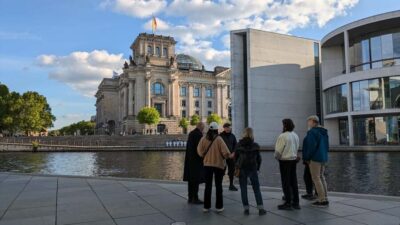
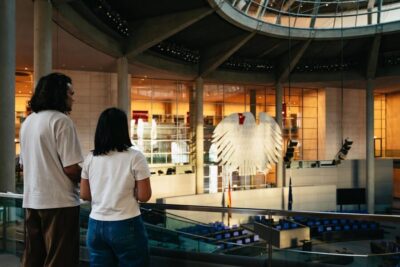
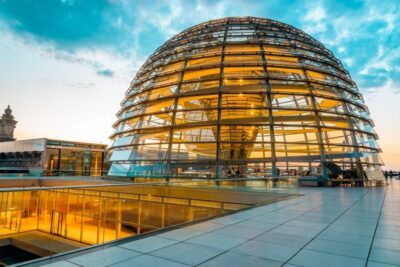
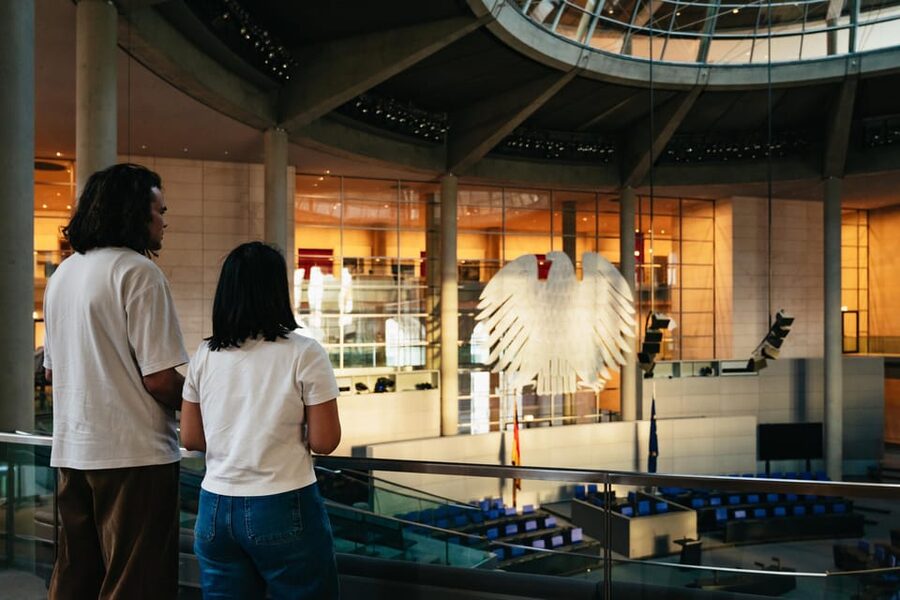
The Reichstag area is a highlight for many people, and for good reason. You’ll see how the building became the symbol it is today, including the story of rebuilding and the modern dome concept after the architect’s original idea did not fully match what Berlin needed. Even from outside, you can understand why this location matters: it is the stage where Germany’s political identity visibly shifted over decades.
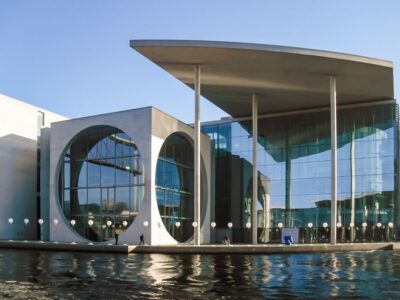
Close by, you’ll encounter the “engine of parliament” style buildings, including the parts where actual committee work happens. The key takeaway is how Berlin organizes transparency and function in one setting. The design lets you understand that not all political spectacle is in the speeches.
You’ll also see the Chancellor’s Office complex, including the scale that makes you realize this is a government built for administration, not just symbolism. It’s described as enormous, with multiple floors and hundreds of offices, and the route even explains how the chancellor’s official spaces connect and what that means for day-to-day operation.
Then there’s the media-facing side, with a modern building where journalists survey government sessions. It’s an interesting contrast to the older stone and historic domes. You’ll see how Berlin’s political world now includes screens, press, and controlled visibility as part of the architectural language.
Practical note: during peak times, exteriors around the parliament district can feel busy, and your taxi route will keep everything moving. The value is that you’ll see it as a system, not a scattered set of buildings.
Brandenburg Gate and the “Parlor” of Berlin

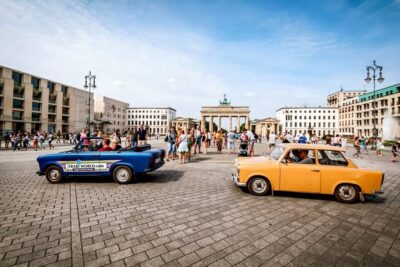
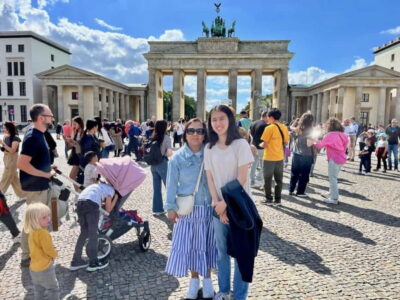
No East-West narrative feels complete without the Brandenburg Gate. From this tour, you get more than the landmark. You get why this place became the city’s stage.
You’ll learn how the gate sits at Pariser Platz and why it has become a kind of Berlin parlor: the area is what guests are meant to see after you arrive in town. You’ll also hear the original isolation caused by walls and separation, because this gate was not simply “a monument in a plaza,” it was part of a divided layout with restricted movement.
The surrounding embassies and rebuilt buildings matter here. Berlin rebuilt around the gate with modernized cubature, so the feel is “restored but not restored to the same.” If you like reading a city’s political posture through architecture, this is a strong stop.
A nearby stop covers a Soviet-era palace-like embassy building, designed to show who held power at the center of Berlin after the American, British, and French embassies were in ruins. The discussion often turns into a lesson about how Cold War politics shaped even the size of courtyards and schools. It’s a reminder that architecture was a messaging tool.
Forum Fridericianum, Book Burning, and Gendarmenmarkt’s Two Churches

This part of the route is a lesson in how ideology leaves marks in public squares.
You’ll pass through the Forum Fridericianum grouping, including the mix of institutions that form the square world around today’s Humboldt University area. One of the most sobering details is the story of May 10, 1933, when books deemed unsuitable by the Nazi regime were burned on the square. It’s one of those moments where you feel the weight of history, even if you’ve seen it in a textbook.
Then the tour pivots to Gendarmenmarkt, which many people consider the most beautiful square in Berlin. You’ll see both “domes” framing the space: the German and French cathedrals. The twist is that they were meetinghouses with cathedral-like towers, rather than classic bishop-centered cathedrals. The French cathedral still holds services in French Sundays, and there’s a small Huguenot museum backdrop that ties directly to the refugees who were allowed to build there after arriving.
If you want a quick win that feels visually rewarding without requiring a museum ticket mindset, Gendarmenmarkt is that. It’s also a great spot for photos because the square is open and the buildings frame you.
East Berlin Atmosphere: Friedrichstraße, Hackeschen Höfe, and Jewish Berlin Sites

As you move eastward, the tour shifts from grand squares to neighborhood textures.
You’ll reach Die Hackeschen Höfe, a restored courtyard ensemble with Art Nouveau charm. The big value here is understanding the layer cake: it was damaged and used for other purposes during GDR times, then restored after reunification. What used to mix work and life with factories and printing workshops now feels like a modern artisan and shopping courtyard, with KPM and the Ampelmännchen vibe showing how East Berlin identity has survived and been marketed in a good way.
Next comes the big rail reality check near Berlin’s major central hub. You’ll see how Berlin has evolved rail planning, and how Bahnhof Zoo was downgraded in that reorganization. Even if you don’t care about trains, the sheer scale of the station halls and levels is a Berlin lesson in infrastructure.
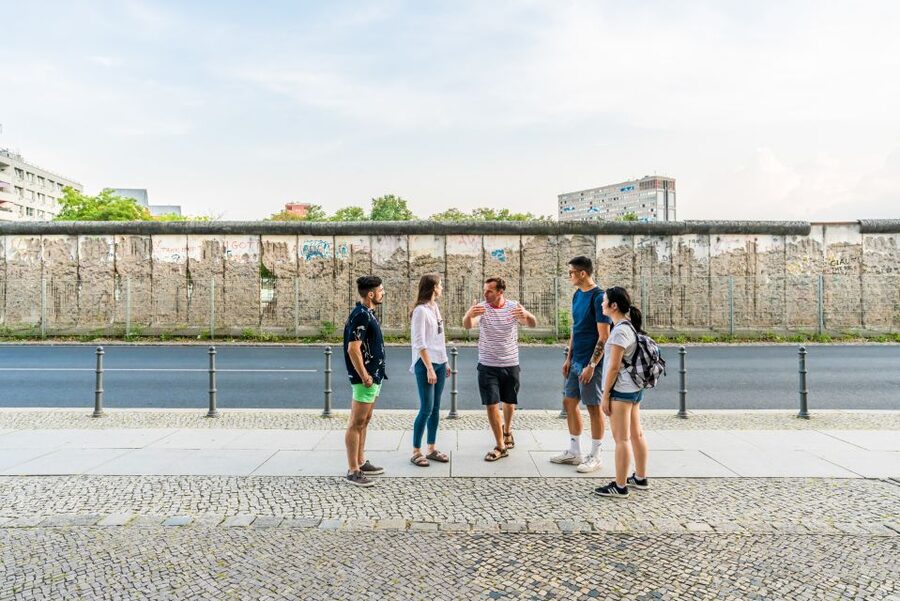
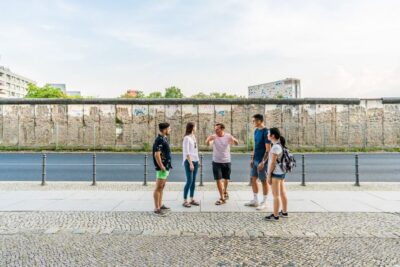
Then the tour hits a powerful Cold War and human-rights thread near the old east-west border area, with the story of Günter Litfin, one of the first deaths after the wall was built, connected to the harbor area. It’s not an “easy” stop, but it’s an essential one if you want real context rather than just looking at walls from a distance.
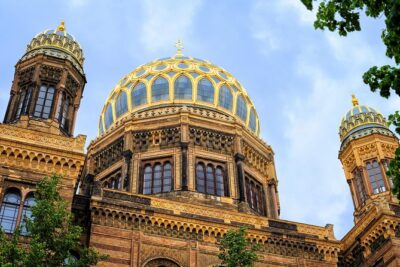
You’ll also get into lively East Berlin streets and nightlife areas around Torstraße, then reach a key cultural stop: the Neue Synagogue area with its Moorish details and golden dome. You’ll hear why security is tight and why the church itself was destroyed in the war, while parts of rebuilding included an exhibition on Jewish life in Berlin. It’s a place where Berlin’s layers include both cultural pride and the aftermath of catastrophe.
And later you’ll cover Friedrichstraße, including why the station mattered when East and West were divided. You’ll hear about the onward journey possibilities during the wall years and how the station was involved in escape attempts. The story points you toward the Palace of Tears idea, even if your taxi stop is about the exterior impression and context.
Unter den Linden, Historic Palaces, and Memorials for War Victims
If Brandenburg Gate is the parlor, Unter den Linden is the formal walkway of Berlin’s self-image.
You’ll see the boulevard designed originally as a calm bridle path from the Berlin Palace area toward the zoo grounds, lined with linden trees that shaped its identity. The stop often connects to the modern buildings along the way, including the sense that the street is both a promenade and a political corridor.
Around the palace zone, you’ll learn about the Kronprinzenpalais and Kronprinzessinnenpalais, which helped crown princes and princesses grow up and were used in later decades for opera-adjacent culture and administration during reconstruction. It’s a good reminder that “royal spaces” did not stay frozen in time.
A quieter but important stop follows at the memorial area with a Käthe Kollwitz sculpture, where wreaths and commemorations connect the space to victims of war and tyranny. This isn’t meant to be a quick “look and go” stop. It’s more a pause, take a breath, and let the meaning land.
Humboldt Forum, Old Berlin Rebuilt, and Nikolaiviertel’s Stage Sets
This tour spends serious time on how Berlin reconstructs itself.
At the Humboldt Forum, you’ll hear how the site was empty for decades, including the parking lot era, before the Berlin palace silhouette became a persistent reference point. You’ll also hear about the long demolition and the later externally accurate reconstruction, including the Schlüter courtyard details. The key point for you: this is not just a museum building. It’s Berlin’s argument that the city can rebuild with intention, but still include modern functions and non-European art collections.
Then you’ll move toward Nikolaiviertel, where you get “old Berlin” as a reconstruction story. The tour frames it as a declared reconstruction effort in the 1980s, when only parts of the older church structure remained. You’ll see the Nikolaikirche and get a glimpse of interiors via the idea of a city museum approach, plus the nearby Knoblauchhaus in Biedermeier style with family life themes.
This part is especially good if you like atmosphere, not just headlines. You’ll likely want to slow down for photos because the area is intentionally photogenic, and the Spree views help.
Spree, Canals, and the Landwehr Canal as Berlin’s Orientation Tool
One of my favorite ways to understand Berlin is through water, and this tour actually uses it.
You’ll get oriented with the Landwehr Canal, explained as part of a Dutch-influenced planning tradition that created about 200 km of waterways across Berlin. The canal’s functions were practical: it helped shorten the meandering Spree, carried shipping for suburbs, and drained swampy areas in places like today’s Kreuzberg and the Tiergarten region.
You’ll learn that Berlin has groundwater only about 80 cm below the surface and that centuries of damming and draining shaped modern urban form. If you ever wonder why Berlin looks the way it does, this is a strong explanation. Water is not an accessory here, it’s part of the city’s logic.
Cold War and WWII Anchors: Topography of Terror and Stauffenberg
When the tour reaches the Topography of Terror, it’s the kind of place you don’t “speed run.” The route frames the site with four layers: Prussian and imperial-era institutions, a major Nazi-era air force administration building presence, and later excavations that uncovered torture cells and Cold War Berlin Wall documentation.
Even though you may not have time to read every panel deeply in a 3-4 hour tour, you’ll get a structure that makes what you see meaningful. This is one reason people love the guided pace. Without that guidance, it’s easy to treat Topography of Terror as a list of exhibits instead of a layered story of terror mechanisms and the city’s transformation.
You’ll also pass the Ministry of Defense area and connect it to the plot of July 20, 1944. The route includes the story of Claus Schenk Graf von Stauffenberg and the execution aftermath, tied to the broader military command narrative. Again, this is history you can connect to specific buildings and a specific moment.
Tiergarten, Beer Gardens, and Checkpoint Charlie’s Photo Logic
Some Berlin history is heavy. This route also gives you breathing space.
In the Tiergarten corner areas, you’ll see park planning inspired by Peter Lenné and get the idea of lakes and water absorption channels built into the landscape. You’ll also learn why Berlin’s beer culture can be more “street and selected beer gardens” rather than a constant Southern-style beer hall scene. If the day lines up right, this is also where you’ll notice how Berlin uses parks like social living rooms.
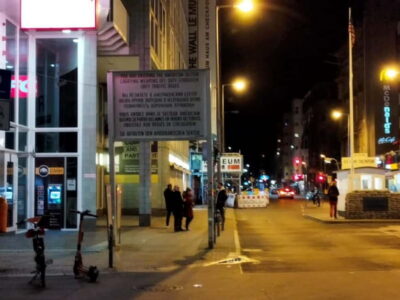
Then comes Checkpoint Charlie. The tour keeps it honest: what you see there is a replica photo point from the 1960s style. The famous sign and hut are part of the display logic, and that matters because it explains why the area draws people globally. You’ll also get the cold-war confrontation reference point from October 1961 as a key reason the site still attracts attention.
Dom Aquarée and How This Tour Ends on a Sensible Note
Many highlights tours end with another long museum queue. This one can end with something practical and fun: the aquarium at Dom Aquarée. You’ll walk through a South Sea style aquarium experience, including reptiles on sandstone plates and a pathway that feels like a self-contained end cap to the day.
Even if you’re not an aquarium person, this ending can work because it lets you decompress. After history-heavy stops, it’s a relief to switch your brain to colors and water life.
Price and What You Actually Get for $150.18 Per Person
At $150.18 per person for about 3-4 hours, you’re not just buying entry tickets. You’re buying:
- a private vehicle with pickup in the S-Bahn ring
- WiFi on board
- guided routing that reduces backtracking
- a narrative that connects far-apart landmarks without you needing a master plan
The best value hits if you want both structure and flexibility. The tour is listed in English and described as customizable to interests in real feedback. You’ll also have enough short pauses to get close looks, which is often where self-guided tours slow down.
If you only want one or two iconic stops, it’s probably more cost-effective to do those by transit. But if you want a coherent Berlin story, taxi time with a strong guide is a good deal.
Should You Book This Berlin East-West Taxi Tour?
Yes, if you want to see a lot of Berlin without turning your day into logistics. It’s especially good for:
- first-timers who want East and West connected in one narrative
- people who dislike long museum days but still want real history
- groups with mixed ages, because the pace includes viewpoints and varied stop types
- anyone who wants the comfort of a taxi while still seeing major architecture
Skip it or choose a different approach if you want hours inside multiple museums. This tour is built for smart stops and big context, not slow reading time.
If you do book it, bring a bottle of water, wear comfortable shoes for quick exterior walks, and have at least a short list of what matters most to you: Cold War stories, imperial architecture, or the modern city rebuild. With a guide like Gunter, that focus helps him steer the day.
FAQ
How long is the private taxi tour?
The tour lasts about 3 to 4 hours.
Is pickup included?
Pickup within the S-Bahn ring is included. Pickup outside the city center or from BER airport can cost extra based on Berlin taxi tariff rules.
What language is the tour offered in?
The tour is offered in English.
Are tickets included for specific stops?
Some stops are listed as free admission, and Humboldt Forum is marked as included with admission ticket. Other stops include free admission tickets as noted.
Is WiFi available during the tour?
Yes. WiFi is provided on board.
Can I cancel for a full refund?
Free cancellation is available up to 24 hours before the experience starts for a full refund. Canceling less than 24 hours before start time is not refundable.
More Tours in Berlin
More Private Berlin Days
More Tour Reviews in Berlin
Recently added around Berlin
Berlin Private Tours, compared.
★ 4.8Private Reichstag and Glass Dome TourFrom $2882,226 reviews
★ 5.0Berlin Private Complete History All Day Walking TourFrom $253474 reviews
★ 5.0Private Walking Tour Berlin Third Reich Hitler and World War IIFrom $192360 reviews
★ 5.0Berlin Private Half-Day Walking Tour: Discover the German Capital’s HistoryFrom $180244 reviews
★ 5.0Private Walking Tour: World War 2 and Cold War Sites in BerlinFrom $192230 reviews
★ 5.0The History of Berlin: WWII PRIVATE Walking Tour With LocalsFrom $143209 reviews
★ 5.0Private Sachsenhausen Concentration Camp tour with trainFrom $338205 reviews
Browse the lists this tour appears in