Tour review · BERLIN WALKING TOURS
Love and War in Berlin: Self-Guided Story Puzzle Walk
Berlin turns into a story you solve yourself. This self-guided puzzle walk, Love and War in Berlin, is built for your pace and uses short challenges to pull you through key WWII-era places, including the site of Hitler’s former war bunker.
I also like how it strings together big landmarks and thought-provoking settings without forcing a group rhythm, so you can pause when the topic gets heavy and then keep going.
One possible drawback: the game is puzzle-first. If you hate hunt-and-peck solving, you might find a few questions a bit frustrating when the answer has to be exact.
Key takeaways before you go

- Start anywhere in your day, not to a fixed tour time, and take breaks without penalty
- Offline play means you can keep moving even if your phone signal is spotty
- A WWII-focused route that includes well-known sites plus places many people walk past
- No human contact, just you and your phone, which helps you avoid crowds
- Flexible route pacing, about an hour on average, with short “look around” moments
- Low price for central Berlin time, especially since several stops note free admission
Berlin on foot, with a few more routes worth comparing
- Discover Berlin Half-Day Walking Tour★ 5.0 · 9,624 reviews
- Berlin: Third Reich and Cold War 2 Hour Walking Tour★ 4.9 · 6,830 reviews
- Berlin: Discover Berlin Walking Tour★ 4.9 · 5,998 reviews
- Berlin’s Best: 2 Hour Walking Tour Third Reich and the Cold War★ 5.0 · 5,486 reviews
A $6 one-hour puzzle walk through Berlin’s hardest chapters

For a small price, this is a smart way to get “Berlin center” time without the classic guided-tour tradeoff. You pay $6 per person, you get a mobile-ticket setup, and the whole experience is built to run like a story game. That means you control the pace instead of being dragged forward every time someone else needs a photo.
The best part is that the format pushes you to look closely. Berlin can be fast to skim. This walk slows you down on purpose, with prompts that make you notice architecture, city planning, and the physical placement of memory in space. And because the theme touches WWII, it gives you a reason to slow down even when you would rather hurry past.
You should also know the experience is designed as private, with no human contact. That’s a big deal for anyone who dislikes group dynamics or wants a quieter way to process difficult history.
How the offline story game actually feels on the street

This is a self-guided experience delivered through a mobile ticket. You do not need an internet connection to play, which is useful in central Berlin where your signal can still be patchy in some stretches.
The flow is simple: you move from one stop to the next, and at each location you complete a short challenge that usually involves looking around for a specific detail. When you have the answer, you advance to the next part of the story.
Two things matter for your enjoyment. First, you can start at any hour and resume later. This makes it easy to fit into a busy day at Museum Island, Mitte, or Alexanderplatz without wrecking your schedule. Second, you should budget enough attention at each stop to actually read what the game asks you to find. If you rush, you will miss the clue and you can end up rechecking the same spot.
In one review, the route was a bit tricky at a seasonal moment when there was a market setup, so you might want to keep an eye on temporary crowd barriers or detours. That’s not unique to this experience, but it can change how smoothly you follow the line.
Alexanderplatz Urania World Clock: time as a world view

You start at Alexanderplatz, at Alexanderpl. 1. The first stop is the Urania World Clock. It’s a large turret-style clock in a public square, and it lets you read the current time in many cities across the world.
Why this works in a WWII-themed walk: it frames the day through a global lens right at the start. You start somewhere that already speaks to connection and modern movement, then the story pulls you toward the political machinery of the 20th century.
Your task here is a classic puzzle-walk opener: look around for the answer to move forward. The challenge makes you physically scan the clock structure and markings, instead of just taking a quick glance and moving on.
Practical tip: this is a public square. Give yourself a few extra minutes at the start if you want photos without feeling like you are behind the game.
The Rathaus: architecture as political stagecraft

Next up is the Rathaus, a major civic building built in the late 1800s in the style of Northern Italy High Renaissance, designed by Hermann Friedrich Waesemann. The tower design is also said to echo a cathedral tower in France, which helps explain why the building feels like it has international references, not just local style.
Your puzzle here is more about reading details in context. You look around the building, find the correct answer, and learn the story of the place as you go.
What I like about this stop is the way it teaches you to notice Berlin’s layers. Even if you only have one hour, it helps you understand that the city’s WWII story is not sitting on top of a blank slate. It sits inside older civic ambition, and the buildings remind you that “power” often looks elegant before it looks ugly.
More self-paced Berlin routes and city games
- Escaping and spying on the Berlin Wall Scavenger hunt
★ 4.5 · 128 reviews - Berlin: Self-Guided Family and School Class Scavenger Hunt
★ 4.6 · 128 reviews - Berlin: “Shadow of the Rubber Duck” Escape Room Experience
★ 4.7 · 95 reviews - Berlin: Scavenger Hunt Self-Guided Tour
★ 4.6 · 79 reviews - Live escape room
★ 3.5 · 32 reviews
Neptunbrunnen in 10 minutes: a “pretty” pause before darker turns

Then the route goes to Neptunbrunnen, the Neptune Fountain built in 1891 and designed by Reinhold Begas. The Roman god Neptune is at the center, and the fountain gives you a quick visual break before the story heads into harsher ground.
The itinerary notes free admission and a short time here. That’s perfect for pacing. It keeps the walk from feeling like a nonstop lecture and gives you a chance to catch your breath.
The puzzle at this stop is again a look-around moment. It trains your attention, so you do not just treat fountains and statues as background scenery.
Marx-Engels-Forum: ideology in a public space
After the fountain, you step into Marx-Engels-Forum, a public park in Mitte named for Karl Marx and Friedrich Engels, authors of The Communist Manifesto. The park was created by authorities of the former GDR in 1986.
This stop matters because it shows how Berlin after WWII became a place where competing systems argued through street-level landmarks. The story isn’t just about one regime. It’s about how different political identities shaped the city you walk through.
Your job is straightforward: look around, solve the clue, and move on. Because the stop is a park space, it can feel calmer than some of the street-side sites. That calm makes the next sections land harder.
Lustgarten and Neue Wache: where public space meets memory

You move through Lustgarten on Museum Island, near the site of the former Berliner Stadtschloss. The park has served different roles across time, including parade ground, mass rally space, and later a public park.
This is one of those locations where Berlin’s modern look can trick you. You can stand in the green space and forget what kind of stage it once was. The puzzle-game format helps correct that by forcing you to connect what you see with what the site used to do.
Then you come to Neue Wache on Unter den Linden. It was erected from 1816 to 1818, planned by Karl Friedrich Schinkel, and it has served as a guardhouse and a memorial to the Liberation Wars. It’s considered a major work of Prussian Neoclassical architecture.
Why I consider this a high-impact stop: the building form is classical and controlled, but the function is about war and remembrance. That mix is the point. Berlin often memorializes through architecture, not only through statues.
If you want a smooth experience here, slow down. Let yourself stand in front of what’s in front of you, solve the puzzle when you are ready, then keep walking. This stop is not a “snack stop.” It is a “pause and recalibrate” stop.
Bebelplatz and the Nazi book burning: a chilling historical lesson
Next is Bebelplatz, known as the site of a Nazi book burning ceremony held on 10 May 1933 in German university cities. It was initiated and hosted by the nationalist German Student Association, and it was meant to steal attention and momentum.
This is one of the most sobering stops on the walk, and the game approach works because it gives you time to look first, then understand. The itinerary notes free admission and a short time here.
For me, the value is that you do not just hear about the event. You also experience how it fits into the city fabric. That placement is part of the lesson. Even when the details feel distant, the ground under your feet is real.
Tip: if you are traveling with kids or anyone sensitive to dark topics, give them permission to step back for a moment. You can pause and resume, and you will need that flexibility here.
Gendarmenmarkt: from ideology to culture in one square
Gendarmenmarkt gets more upbeat on the surface, but the story thread stays sharp. The square is named after the Gens d’armes cuirassier regiment. Between the two churches, a new theatre was built, now known as the Konzerthaus Berlin.
This stop is listed with free admission and short time. It’s a useful reset because the game gives you a different kind of clue to solve: not just war, but the cultural institutions that often followed or replaced them.
One practical reason I like this stop for a self-guided walk: the square is easy to orient in. Even if you get slightly turned around, you can visually find your way back to the main structures and then solve the challenge.
Hamburg’s state representation: politics happens in plain sight
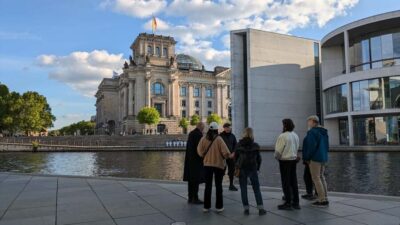
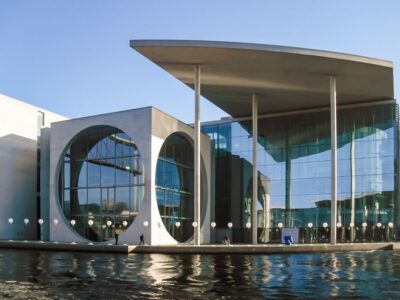
Later, the route heads to the state representation of the Free and Hanseatic City of Hamburg in Berlin, at Jägerstraße in the government district. The site hosts political daily life and over 500 events and encounters each year, including discussion events on current political topics. It’s also described as a place where Hamburg makes politics in the capital and participates through the Federal Council.
The puzzle here again pushes you to look around and connect what you see with what the place does. It’s a reminder that history is not sealed in the past. It continues through institutions.
This stop is also a good moment to breathe. After memorial and war themes, it helps to see how a modern government building functions as part of daily life. It makes the whole walk feel less like a museum tour and more like a city tour with context.
Memorial to the Murdered Jews of Europe: last stop, real reflection
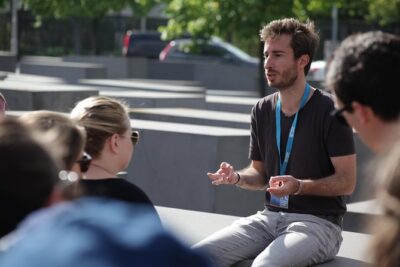
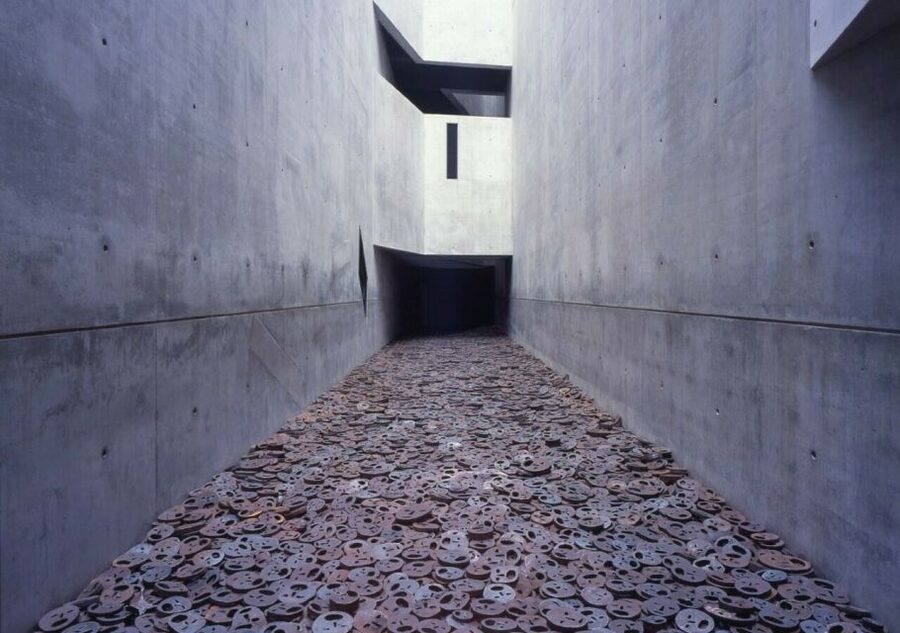
The route’s finale is the Memorial to the Murdered Jews of Europe, established by a 1999 German parliament decision and designed by New York architect Peter Eisenman, opened ceremonially in 2005.
This is likely the most emotionally intense stop on the walk. The itinerary again uses the look-around puzzle mechanic, which can feel less like a “quiz” and more like a way to structure your attention.
How to get the most from this ending: do not treat it like a quick photo stop. Let the space affect you. Then, when you are ready, solve the final challenge and take a moment before leaving. The private format helps here because you can control your pace without worrying about what anyone else is doing.
Also, note the walk ends at Cora-Berliner-Straße 1. That means you are finishing in an area where you can easily keep moving through the city afterward.
Price, value, and why this format works in Berlin
$6 per person for about an hour is a very solid deal, especially for central Berlin. Guided tours often cost multiple times that, and they come with forced pacing. Here, you get flexibility plus privacy.
You also get several advantages that feel practical, not gimmicky:
- Set your own schedule and pause whenever you want
- No internet needed to play
- No crowd pressure, since it is private and you avoid the typical group scrum
- Several listed stops note free admission, which keeps the day budget-friendly
If you already planned other classic sights, this can act like an intelligent connector. It helps you understand what you are seeing, not just what it looks like.
Who should book Love and War in Berlin?
This is a good fit if you want:
- A self-guided experience that you can do at your speed
- WWII context without joining a noisy group
- A walk that stays mostly in central, recognizable areas around Mitte and Museum Island
- A low-cost way to spend focused time in Berlin history
It might be less ideal if:
- You dislike puzzles or want zero brainwork while sightseeing
- You hate reading clues and solving for exact answers
- You only want passive sightseeing with no “look for this detail” tasks
Should you book it?
Yes, if you want a quiet, controlled way to explore Berlin’s WWII landscape in about an hour. The price is low, the pacing is flexible, and the offline puzzle format makes you pay attention without needing a human guide.
I’d skip it only if puzzles frustrate you or if you would rather have someone explain everything out loud. Otherwise, this is a smart, value-packed option for seeing central Berlin while actually learning what the places mean.
FAQ
Is this tour a group tour or private?
It is private, and only your group participates. The experience is also described as safest to book because it involves no human contact.
How long does the walk take?
The duration is approximately 1 hour on average.
What does it cost?
The price is $6.00 per person.
Do I need an internet connection?
No. You can play offline and you do not need an internet connection to play.
What language is it offered in?
It is offered in English.
Where does it start and end?
The start is Alexanderpl. 1, 10178 Berlin. The experience ends at Cora-Berliner-Straße 1, 10117 Berlin.
Is there a physical guide with me?
No. A physical tour guide is not included.
Are any admissions required at the listed stops?
Most of the route is built around public places, and the itinerary specifically notes free admission at Neptunbrunnen, Bebelplatz, and Gendarmenmarkt.
Can I bring a service animal?
Yes, service animals are allowed.
What if my plans change?
There is free cancellation. You can cancel up to 24 hours in advance for a full refund.
More Self-Guided Berlin
Keep Walking Berlin
More Tour Reviews in Berlin
Recently added around Berlin
Berlin Walking Tours, compared.
★ 5.0Discover Berlin Half-Day Walking TourFrom $249,624 reviews
★ 4.9Third Reich and Cold War 2 Hour Walking TourFrom $236,830 reviews
★ 4.9Discover Berlin Walking TourFrom $235,998 reviews
★ 5.0Berlin’s Best: 2 Hour Walking Tour Third Reich and the Cold WarFrom $245,486 reviews
★ 4.8Hidden Backyards Guided Walking TourFrom $235,360 reviews
★ 5.0Third Reich Berlin: Hitler and WWII Walking TourFrom $243,301 reviews
★ 4.6Alternative Berlin Walking TourFrom $291,204 reviews
★ 4.9Third Reich, Hitler, and WWII Walking TourFrom $201,133 reviews
Browse the lists this tour appears in