
Tour review · HISTORICAL TOURS
Historic center of Berlin – Tour in Italian
Berlin changes fast when you walk it.
This 3.5-hour small-group tour in Italian strings together Berlin’s most important political moments, from the Berlin Wall era to WWII memory sites, with a guide who explains the why behind the stone and street layout. I especially like the way the route starts at Potsdamer Platz and then keeps moving logically through the city’s turning points, and I like that the stops are packed with context you can’t easily spot on your own. One consideration: this is a walking tour with outdoors time and emotional subject matter, so bring comfortable shoes and expect the pace to be steady.
The tour is priced reasonably for a guided 3.5-hour route in central Berlin, and it includes the local guide and local taxes. You’ll also get practical help near the end, when the guide shows you how to continue to major sights around Museum Island, including Pergamon Museum. The possible drawback is simple: since it is built around major sights, you will not spend long inside buildings, and you may want a follow-up plan if you want deeper museum time.
Key things to know before you go
- Italian-speaking guide with clear storytelling, including named praise for guides like Paolo, Giulia, Fabio, Chiara, Elena, and Daniele
- Small group size (max 28) means you can hear explanations without feeling lost in a crowd
- A route focused on Cold War and WWII memory, including Topography of Terror, Checkpoint Charlie, and the Holocaust Memorial
- Outside-only viewpoint pacing, with the Reichstag stop used for guidance on booking the dome visit
- Mobile ticket and no admission fees at the listed stops, so you can focus on walking and listening
- Ends at Pergamon Museum, with directions to help you plan the rest of your day
More Berlin ideas for the space still left in the itinerary
- Berlin: Natural History Museum Entrance Ticket★ 4.6 · 3,382 reviews
- Berlin: World Heritage Cruise to Potsdam★ 4.5 · 1,435 reviews
- Berlin Historical Highlights Walking Tour★ 4.9 · 657 reviews
- Berlin Private Complete History All Day Walking Tour★ 5.0 · 474 reviews
Why this Italian walking tour fits Berlin’s “big story” vibe
Berlin is a city of layers. In one block you can feel the past, the politics, and the rebuilding all at once. This tour is built for that reality. Instead of trying to cover everything, it walks you through a sequence of places tied to Germany’s most turbulent decades, so you start seeing patterns, not just postcards.
The Italian guide is the main ingredient. The best part is not only what you see, it is how the guide connects the buildings and locations to decisions people made, propaganda they used, and divisions they enforced. You leave with a stronger mental map: where the lines were drawn, what the symbols meant, and how reunification changed the meaning of places you might already recognize.
Also, I like that the tour keeps shifting between heavy moments and more “readable” landmarks. For example, you will have emotional stops like the Holocaust Memorial, and then you quickly return to famous visual anchors like Brandenburg Gate and Unter den Linden. It makes the experience easier to carry.
Meeting at Potsdamer Platz, then getting oriented fast
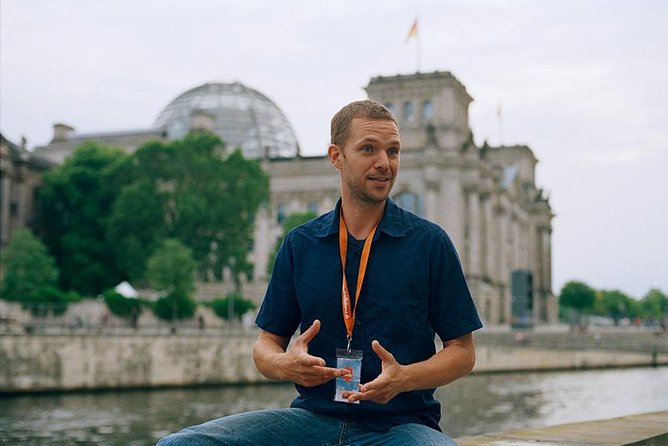
You start at Potsdamer Platz 10, near the S and U-Bahn station. The meeting point is very specific: look for the blue bicycle with the Vive Berlin Tours logo flag. That matters because Berlin’s transit hub area can be busy, and a clear meeting marker saves time.
Start time is 10:00 am, and the tour runs about 3 hours 30 minutes. The duration is long enough to feel like you did something meaningful, but short enough to still have energy left for museums afterward. The group size is capped at 28, which helps with the “hear the guide” part of a walking tour.
A practical note: the tour operates in all weather. Berlin weather can turn quickly, even in calmer seasons, so wear layers and plan for wet ground. You’ll be outdoors a lot, and you’ll be walking between central neighborhoods.
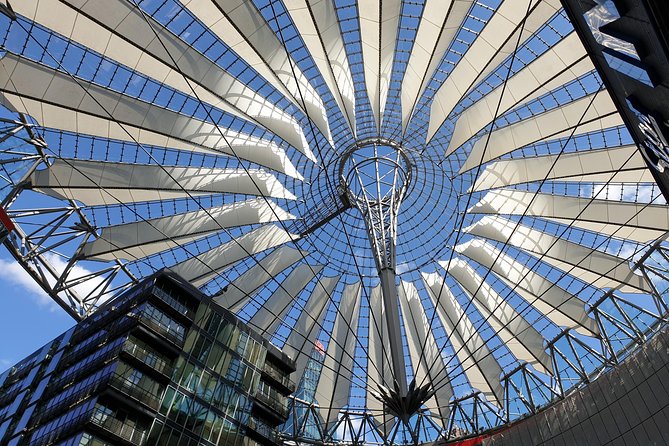
Potsdamer Platz and Sony Center, how modern Berlin keeps old scars visible
Your first stretch is about orientation and contrast. Potsdamer Platz is one of Berlin’s most well-known modern squares, and it’s also a strong starting point because it sits right where earlier Berlin layouts and wartime damage shaped later reconstruction.
From there, you move into the Sony Center area. This stop is a good reminder that Berlin did not only rebuild, it also chose what to preserve. The tour highlights how remnants of a destroyed earlier square were preserved and blended into the contemporary architecture. That is a useful lens for the rest of the walk: you learn to read the city as a record, not a clean slate.
What to watch for here is less about one building detail and more about the contrast. This is your “Berlin now” moment before the tour shifts into Berlin “then.”
Topography of Terror and the Gestapo and SS footprint
Next comes one of the strongest stops on the route: Topography of Terror. This isn’t a quick glance. The guide’s job here is to help you understand how Nazi rule is remembered in the exact places tied to repression.
The key point is location. You learn this is where the headquarters of the Gestapo and SS were located. From this area, you can also see other significant buildings tied to the Nazi period, including the former Nazi aviation ministry and the Martin Gropius Bau museum. There’s also an especially important visual reference: an original segment of the Berlin Wall.
This stop can feel heavy because it is precise about where power operated. I recommend treating it like a moment to slow down. Even if you usually prefer “see and go,” don’t rush this one. When the guide explains how the site is used today, it becomes easier to understand Berlin’s public memory choices.
- Berlin: Reichstag, Dome and Government District Guided Tour
★ 4.7 · 18,288 reviews - Berlin: 1-Hour City Tour by Boat with Guaranteed Seating
★ 4.3 · 16,993 reviews - Berlin: Boat Tour Along the River Spree
★ 4.4 · 11,252 reviews - Discover Berlin Half-Day Walking Tour
★ 5.0 · 9,624 reviews - Berlin: Hop-on Hop-off Bus Tour with Live Commentary
★ 4.3 · 8,579 reviews
Cold War hotspots: Checkpoint Charlie, the Aviation Ministry, and the wall line
After Topography of Terror, the tour turns clearly toward the Cold War story, and it does it with landmarks you already recognize.
Checkpoint Charlie is the classic “hot corner” of the Cold War. The guide talks through how the Berlin Wall was constructed and how the city was divided under communist dictatorship. The useful part is not just the famous name, it is how the guide ties it to everyday movement, control, and the tension of crossing lines.
Then you continue to the massive Aviation Ministry of Berlin building. The tour frames it in two eras. First, it was built by the Nazi dictatorship to house the offices of the Ministry of Aviation led by Goering. Later, in Cold War times, it became part of the “home of the ministries” for the communist dictatorship. Today, it is used by a ministry of the Federal Republic of Germany.
That’s the real payoff of this stop. You start to see the pattern that many Berlin buildings follow: they get reused, renamed, and reinterpreted, while the big idea of control remains visible in architecture and scale.
Hitler’s last days at the Fuhrerbunker, with context you can actually use
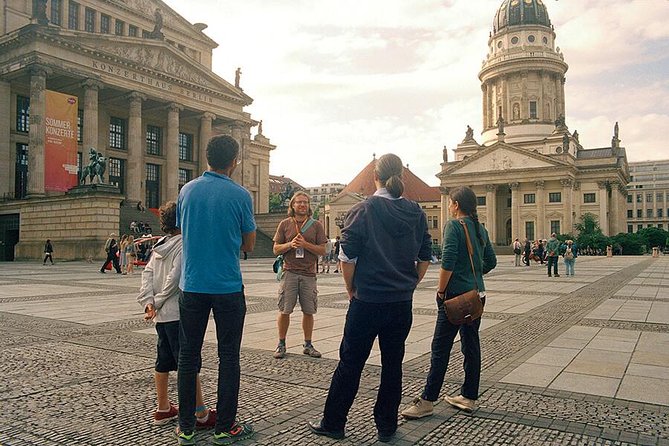
The tour then moves to Fuhrerbunker, the site where the bunker was and where Hitler spent his last days. This stop is short, but the guide’s explanation matters because it helps you understand what the place meant at the time and what the meaning is now.
A short stop can feel unsatisfying if you came expecting a full history lesson. The difference here is that the guide uses the time to give you the key context you need to connect the bunker era to what you have already learned at Topography of Terror and Checkpoint Charlie. By the time you reach this point, your understanding of Berlin’s political whiplash is already in place.
If you’re someone who likes walking with a storyline, this is a good moment to pay attention and not just take photos.
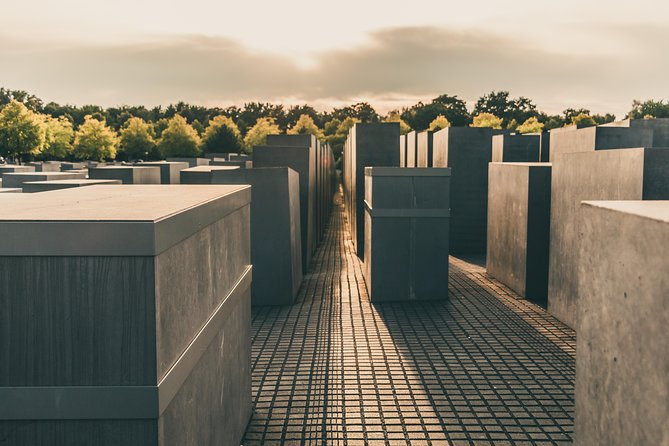
Holocaust Memorial to the Murdered Jews of Europe, serious and guided
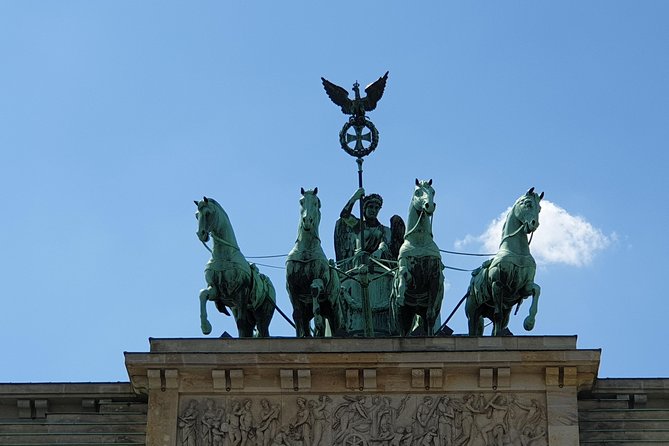
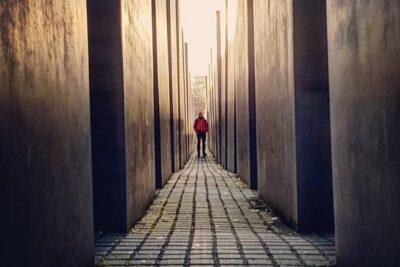
Next is the Holocaust Memorial, also called the Memorial to the Murdered Jews of Europe. The tour describes it as a place of great emotion, and the guide will share stories connected to Germany’s greatest crime committed during Nazism.
This is not a stop for racing. Even if the visit is brief, the guide’s narration is the main value. You should go in with a mindset of respect and space for reflection, because a memorial like this works best when you let it slow you down a little.
After this point, the tour keeps moving, so your best strategy is to mentally “reset” and then continue with patience. Berlin’s story is heavy, but the walk helps you keep it connected instead of fragmented.
Reichstag, Brandenburg Gate, and Unter den Linden: famous views with real meaning
Your next phase becomes more visually iconic.
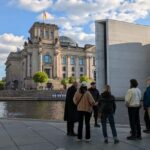
At the Reichstag Building, you will see it from outside. The guide explains how to book a visit to the dome. That outside-only format is not a limitation so much as a planning tool. You get the landmark moment now, then you can decide later whether you want to spend extra time for the dome experience.
Then you hit Brandenburg Gate, Berlin’s most famous gateway. The guide shares the story of the gate evolving from a symbol of royal strength to a Cold War symbol, and then to an icon of German reunification. Even if you’ve seen the gate in photos, this kind of explanation changes how you read it in real space.
Next you walk through Unter Den Linden, a grand avenue that once served as access to the emperor’s palace. The guide points out how you can recognize construction from different periods and how war left wounds in the city. This is where your walking comprehension really clicks. The avenue becomes more than a street, it becomes a timeline you pass through step by step.
A tip: if you want photos, this is one of your best windows. It’s broad, legible, and the landmarks are easy to frame. Just keep an eye on the guide so you don’t lag behind.
Bebelplatz and the book burning memorial, where propaganda leaves a paper trail
You then reach Bebelplatz, known for the book burnings during the Nazi dictatorship. The square also connects to education and religion, including the seat of Humboldt University and the Catholic Cathedral.
The tour makes this stop more than a fact by adding the Book Burning Memorial at Bebelplatz. The guide explains the monument that remembers the infamous propaganda action. This is one of those Berlin “you can understand it instantly” moments, because the symbolism is built into the memorial itself. The guide’s narration helps you connect the action to how regimes used culture and fear to reshape society.
If you like history that has a clear human mechanism, this is a standout. It also helps set up what comes next with the university area.
Humboldt University area, Neue Wache, Berliner Dom, and the walk into Museum Island
After Bebelplatz, you spend time around Humboldt University (Humboldt Universität). You learn the university’s importance and hear about some of its most famous students. This is a good shift from propaganda to ideas. It reminds you that education and thought are also part of how societies rebuild after catastrophe.
Next is Neue Wache, a memorial at the rejection of war and its horrors. The design of a mother crying for her son, a soldier who fell in battle, is described in the tour. This stop is short, but the message is clear and emotionally direct.
Then comes Berliner Dom. The guide explains its significance and compares its idea to St. Peter’s for the Lutheran religion, which gives you a useful frame for why the building was made and how it fits into Berlin’s religious and civic identity.
Finally, you end at Museum Island, a UNESCO World Heritage site. The guide finishes the tour here and gives directions for what to see next. The tour concludes near Pergamon Museum at Bodestraße 1-3, which is a major reason the tour works well for many first-time Berlin plans.
And since the guide points you toward how to visit the museum, you can use this end point as your transition from walking story to deeper indoor time. If you’re planning to go inside, this is where you’ll appreciate ending at a museum cluster rather than somewhere far away.
Price and value for a 3.5-hour Italian guided route
At $27.91 per person for about 3.5 hours, this is a fairly strong value for a central Berlin guided walk. The big reason is that you get a local guide for a long stretch of time, plus local taxes are included. Also, the itinerary’s key stops are described as free admission at the moments you visit, so you are not paying over and over for entry fees just to follow the narrative.
Where you should be realistic: food and drinks are not included, and you will be walking outside most of the time. So your total cost depends on how you handle meals and any optional museum visits afterward.
Group cap matters too. With a maximum of 28, you should generally be able to hear the guide. And the Italian language focus is a real plus if you want the story delivered in a way that feels natural instead of translated after the fact.
Who this tour is best for, and who might want a different plan
This tour is a great fit if you want a guided “Berlin story” that connects multiple eras without turning into an overwhelming museum day. It’s also ideal if you enjoy walking and learning, and if you prefer a narrative route instead of a random list of landmarks.
I would particularly recommend it if:
- you want to understand Berlin’s division and reunification beyond surface facts
- you like history explanations tied directly to specific locations
- you are planning to do museums afterward, since it ends near Museum Island
You might want to choose something else if:
- you mainly want inside access and long museum time during the tour
- you have very limited mobility or cannot comfortably walk a central route of about 3.5 hours
- you are not looking for WWII and Cold War memory sites in one compact timeline
Should you book this Berlin historic center tour in Italian?
If you want a first taste of Berlin that actually explains what you are seeing, I think this is an easy yes. The strongest argument is the storytelling structure: the route is built to connect Potsdamer Platz to Nazi-era memory sites, then to Cold War landmarks, and finally into the iconic center near Pergamon Museum. Guides like Paolo, Giulia, Fabio, Chiara, Elena, and Daniele earn strong praise for being prepared, courteous, and attentive, which matters a lot when the topic is intense and the walk is long.
Book it if you want guidance, context, and a clear plan for your day. If you would rather build your own route with no narrative, you could do the sights on your own, but you would miss the “why this place matters” thread that makes Berlin click.
In short: if Italian guidance and a focused walking storyline are your style, this is a smart way to get your bearings fast.
FAQ
What language is the guide?
The tour is guided in Italian, with an Italian-speaking guide providing the commentary.
How long is the tour?
The duration is approximately 3 hours 30 minutes.
Where does the tour start and where does it end?
It starts at Potsdamer Platz 10, 10785 Berlin. It ends at Pergamon Museum, Bodestraße 1-3, 10178 Berlin.
What landmarks will we see?
You will pass major sites including the Berlin Wall area references, Topography of Terror, Checkpoint Charlie, the Holocaust Memorial, the Reichstag (outside), Brandenburg Gate, Unter den Linden, Bebelplatz and its book burning memorial, Humboldt University area, Neue Wache, Berliner Dom, and Museum Island.
Is the group size small?
Yes. The tour has a maximum of 28 travelers.
Do I need admission tickets for the stops?
The tour information indicates admission tickets are free for the listed stops.
Are food and drinks included?
No. Food and drinks are not included, and drinks are also not included.
What is the cancellation option?
Free cancellation is available. You can cancel up to 24 hours in advance for a full refund.
More Historical Tours in Berlin




More Tours in Berlin

More Tour Reviews in Berlin
Recently added around Berlin


Historical Tours, compared.
 ★ 4.6Natural History Museum Entrance TicketFrom $123,382 reviews
 ★ 4.5World Heritage Cruise to PotsdamFrom $251,435 reviews
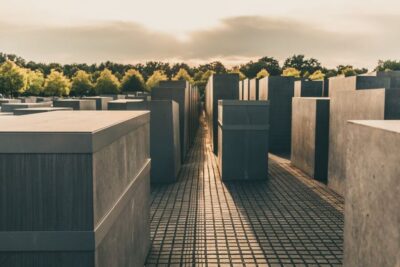 ★ 4.9Berlin Historical Highlights Walking TourFrom $389657 reviews
 ★ 5.0Berlin Private Complete History All Day Walking TourFrom $253474 reviews
 ★ 4.5Historic Boat Sightseeing City Center TourFrom $33415 reviews
 ★ 4.8Cold War Era History Guided Bike TourFrom $35413 reviews
 ★ 5.0Berlin Craft Beer & Cultural Tour With SnackFrom $143343 reviews
 ★ 4.7Small group Potsdam: A Journey Through History and PalacesFrom $659317 reviews
Browse the lists this tour appears in