
Tour review · BERLIN COLD WAR & WALL TOURS
Karl-Marx-Allee Tour: Life and Architecture in East Berlin
Karl-Marx-Allee looks like a boulevard, reads like politics. On this 2-hour walk, you connect the big East Berlin building style to the people, plans, and power struggles behind it, from early-1950s rebuilding to the June 1953 uprising and life after the Wall.
I like the small group setup, capped at 15, and the fact the tour is offered in English with a local expert guiding you stop to stop. I also love that the stops are set up so you focus on interpretation, not paid entries, since admission at the listed sights is free.
One consideration: the whole route is tightly timed, so it’s built for efficient context, not slow wandering. If you want to stare at every façade for a long time, you may wish you had more hours.
Key points to know before you go
- Small-group feel: maximum of 15 people, so questions and follow-ups are realistic
- English-led: clear explanations with real local context for this specific East Berlin stretch
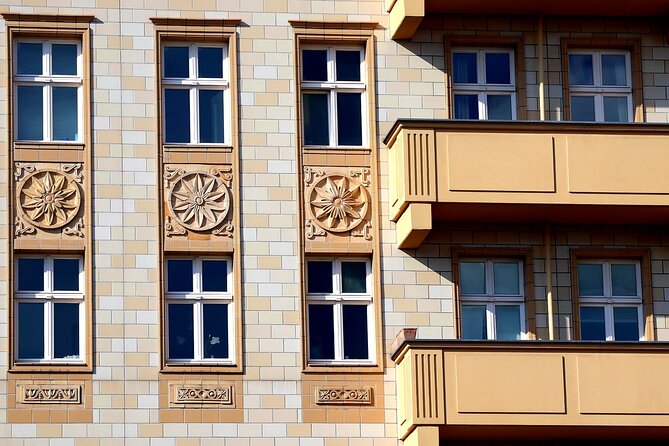
- Architecture as evidence: you’ll learn how the buildings worked as planning, propaganda, and lifestyle
- Practical pacing: about 2 hours with seven scheduled stops, so it fits a busy day
- Personal storytelling: guides like Martina are praised for humor, organization, and making the period easier to grasp
- End near Alexanderplatz-area transit: the tour finishes at Strausberger Platz with an easy onward walk
Other ways to read the Wall and divided Berlin in the street
- Berlin: Third Reich and Cold War 2 Hour Walking Tour★ 4.9 · 6,830 reviews
- Berlin’s Best: 2 Hour Walking Tour Third Reich and the Cold War★ 5.0 · 5,486 reviews
- Skip-the-Line: Berlin Wall Museum at Checkpoint Charlie★ 4.1 · 2,041 reviews
- Cold War, Berlin Wall, Spies and the East Side Gallery★ 5.0 · 1,024 reviews
Why Karl-Marx-Allee architecture feels different when you know the story
Karl-Marx-Allee is the kind of place that looks confident and symmetrical at first glance. But with the right guide, you start seeing the blueprint behind the beauty, and the power behind the blueprint.
This walk is interesting because it treats buildings like historical documents. You’re not just spotting an Henselmann façade or a postwar modernist block, you’re learning why East German leaders wanted specific designs, what they promised residents, and how those promises played out in politics.
And you also get the uncomfortable parts, like the 17 June 1953 workers’ uprising site and how monuments were used to shape memory. That combination, architecture plus consequence, is the real value here.
Getting there and how the 2-hour route works
You start at U Frankfurter Tor, 10243 Berlin. The end point is Strausberger Platz, Strausberger Pl., 10243 Berlin, on the eastern side of the roundabout, about a 10-minute walk from Alexanderplatz.
The schedule is built around short, focused stops: you’ll spend roughly 15 to 20 minutes at each of seven locations, for a total of about two hours. That time structure matters. It means you’ll keep moving, with a clear theme at each stop, instead of getting stuck in information overload.
A practical bonus: the experience uses a mobile ticket, and it’s designed to be easy to fit into a day because it’s near public transportation. The tour is offered in English, and it’s set for most people to join, with service animals allowed.
Frankfurter Tor to Laubenganghäuser: rebuilding dreams in concrete
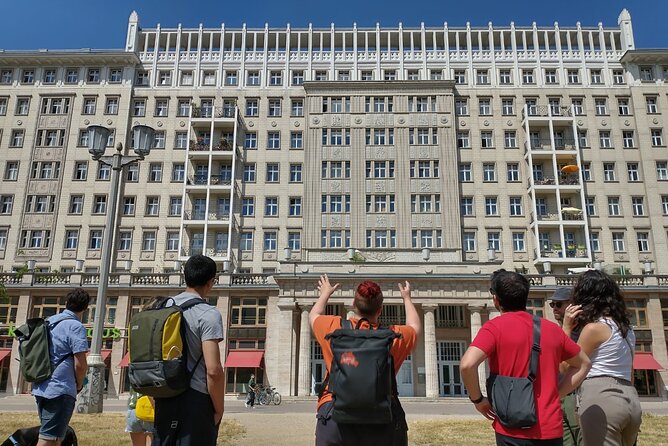
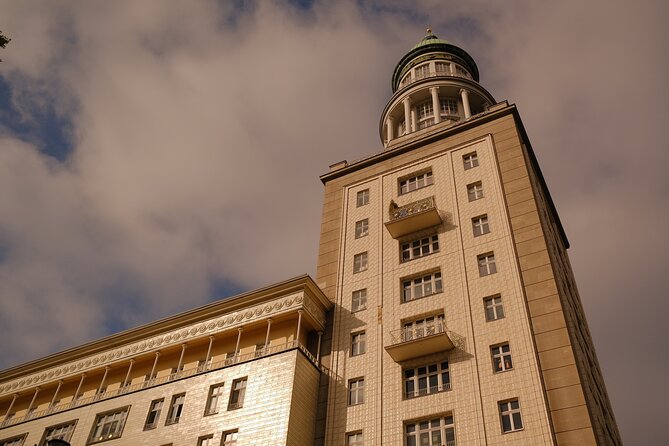
Your first stop is Frankfurter Tor, where you get to admire the symmetry of the towers built by Herman Henselmann. Then the tour turns the key from aesthetics to intent, explaining how plans for what became the first socialist street in Germany took shape in the early 1950s.
This is where the “why” starts to click. The area’s story isn’t just about architecture. It’s about mobilizing thousands of volunteers through a national rebuilding program, then turning that momentum into an iconic urban statement. Even if you’ve seen East Berlin from other angles, this kind of explanation helps you read the boulevard as a tool, not just a backdrop.
Next comes Laubenganghäuser, a modernist set of buildings connected to the immediate post-WWII years and the ideas of Hans Scharoun. You’ll hear how his utopian urban thinking formed in the ashes of destroyed Berlin, then got rejected by the new East German regime soon after.
That contrast is one of the most useful ideas on the tour. You’re not just learning what got built, you’re learning what got rejected, and what that reveals about the political boundaries of the time.
Hochhaus an der Weberwiese to 17 June 1953: luxury, propaganda, and limits
Stop three is Hochhaus an der Weberwiese, presented as a prototype for the rest of the socialist Karl-Marx-Allee. The tour connects the building’s early tenants to an unusual promise for the period: unprecedented luxury.
Then comes the shift into power. This project didn’t stay neutral. It became a propaganda tool, and it even pulled in attention from Western architects. In other words, the East German leadership was not only building housing, they were stage-managing an image of progress that could be noticed beyond their borders.
After that, you head to the Gedenkstätte Arbeiteraufstand 17 Juni 1953. Here the tour gets tense in the right way. You’ll learn about the mass uprising started by disgruntled workers in June 1953, one that almost toppled the socialist government of East Germany.
You’ll also see the controversial monument dedicated to the uprising. That “controversial” detail matters because it reminds you that public memorials are never just about the past. They are about today’s message, and who gets to tell the story.
Other ways to read the Wall and divided Berlin in the street
- Berlin: Guided Bike Tour of the Berlin Wall and Third Reich
★ 4.7 · 499 reviews - Berlin: Cold War Walking Tour on Berlin Wall Route
★ 4.8 · 437 reviews - Berlin: Cold War Era History Guided Bike Tour
★ 4.8 · 413 reviews - East Berlin and the Wall: Walking Tour
★ 4.9 · 407 reviews - DDR Museum Berlin Admission Ticket
★ 4.0 · 352 reviews
Café Sibylle to Karl-marx-bustendenkmal: ideology you can point at
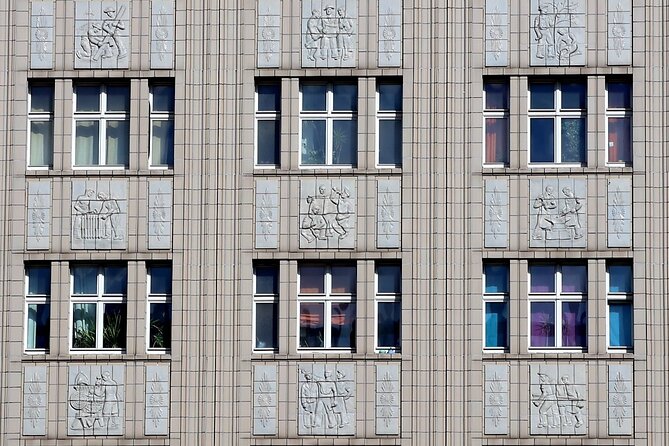
At Café Sibylle, the tour links daily life and political symbolism in a very concrete way. You’ll hear how this high-profile café on Karl-Marx-Allee ties into the statue of Joseph Stalin that stood nearby until 1961.
This stop helps you understand why East Berlin often feels like two layers at once. Buildings and public spaces were designed to host routine life, but they were also wired for ideology, with leaders placed into the city’s visual map.
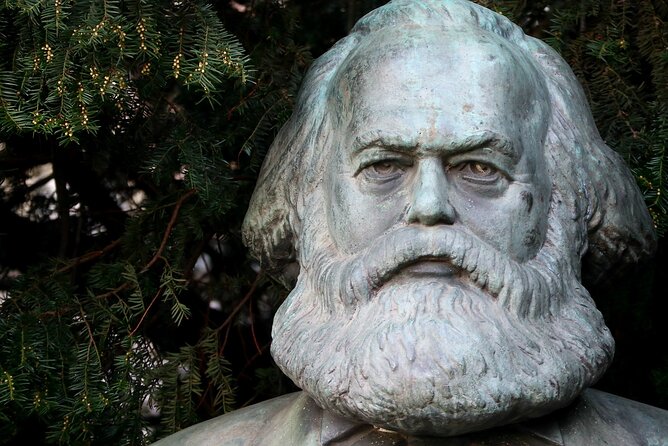
Then you meet Karl-marx-bustendenkmal, connected to Karl Marx, author of The Communist Manifesto. Here the tour moves from statues and symbols into everyday impact, explaining how socialist ideology affected life in East Berliners’ daily routines.
This is a good moment for you to think beyond “what did they build?” and ask, “how did they want people to think?” The guide’s job is to connect those dots quickly, and the best part of this tour is that it keeps doing that: architecture to politics to lived experience.
Strausberger Platz after the Wall: what changed, what didn’t
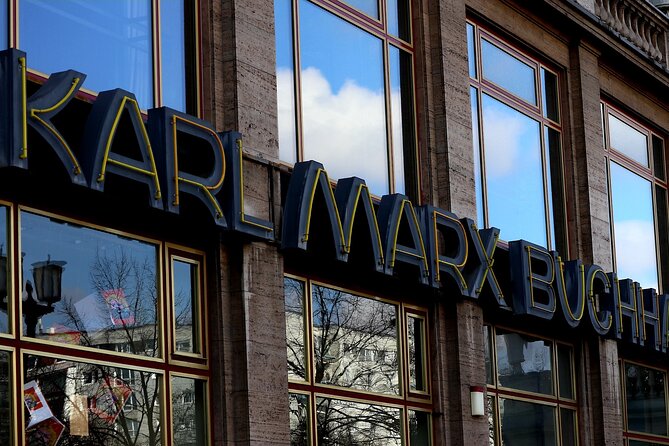
Your final stop is Strausberger Platz. You’ll admire another impressive example of Hermann Henselmann’s style, and then the tour brings things up to date by discussing life along Karl-Marx-Allee after the Fall of the Berlin Wall and how the area functions today.
This ending is smart for practical travelers. It doesn’t leave you stuck in 1953 or 1961. Instead, you get a bridge to the present, so the walk ends with a sense of where you are now and why the architecture still matters.
It also gives you a useful mental trick: look at each building and ask what role it played back then, and what role it plays now. That question keeps your eyes busy on the return trip to the street.
Guides, storytelling style, and why the tour rating stays so high
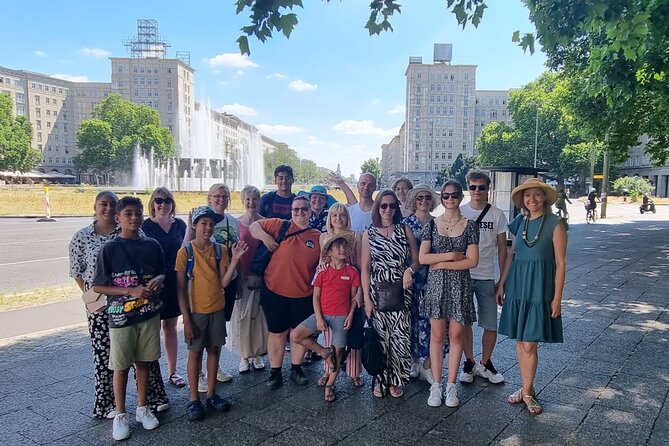
The guides for this route get praised for more than just facts. Martina, in particular, is repeatedly highlighted for depth of historical knowledge and passion, with a sense of humor that makes a complex political period easier to hold in your head.
Several comments point to organization and strong presentation. The guide also tends to use prepared materials, even supplementing with original examples pulled from online archives, which shows real prep rather than a generic script.
And there’s another detail that affects the feel of the tour: one review describes Martina as having lived parts of the period under the communist regime. Even if you do not share that background, it tends to make the stories feel less like textbook summaries and more like lived interpretation.
If you like walking tours that treat the street as a classroom, this guide style works well. If you only want a quick photo walk, you might feel you’re getting too much meaning per minute.
Price and value: what $30.01 buys you on a 2-hour walk
At $30.01 per person for about two hours, you’re paying for interpretation, not entry fees. Every listed stop shows admission as free, which keeps your costs predictable.
You also get an expert local guide, a route with seven themed stops, and a group cap of 15. In practice, that small-group size is what makes the price feel fair. You’re more likely to get a direct answer when you ask why a certain design choice mattered, rather than getting a one-way lecture.
This is also a tour that tends to get booked ahead. On average, it’s booked about 18 days in advance, so I’d treat it as something worth reserving before you finalize your Berlin plan.
Who should book this Karl-Marx-Allee architecture tour
You’ll get the most out of this tour if you fit at least one of these:
- You want East German history that is anchored to real buildings, not just dates on a screen
- You like architecture, but you also want the political story behind the architecture
- You’re short on time and want a structured route that covers a lot of ground in two hours
- You enjoy guides who can balance serious topics with humor and clear organization
It’s also a good fit if you’re traveling with someone who might not read a lot of history before a trip. The stop-by-stop structure keeps it moving, while the guide’s storytelling helps the setting feel human.
Should you book this tour?
Yes, if you want a tight, guided route through one of East Berlin’s most iconic building corridors, and you care about how planning and ideology shaped everyday life. For the money, you get a guided explanation of multiple key stops with free admission at the sights, plus a group size that usually keeps the experience personal.
I’d skip it or consider another option if you hate politics in any form, or if you’re hoping for a slow, long look at fewer places. This walk is designed for context in a short window, so it trades lingering for understanding.
FAQ
How long is the Karl-Marx-Allee walking tour?
The tour lasts about 2 hours.
Is the tour offered in English, and how many people are in the group?
It is offered in English, with a maximum of 15 travelers.
Where does the tour start and where does it end?
It starts at U Frankfurter Tor, 10243 Berlin, and ends at Strausberger Platz, Strausberger Pl., 10243 Berlin. The end point is on the eastern side of the Strausberger Platz roundabout, about a 10-minute walk from Alexanderplatz.
Do I receive a mobile ticket?
Yes, the tour includes a mobile ticket.
Are there paid admission fees at the stops?
The listed sights show admission ticket free at each stop, so you should not need to pay for entry as part of the visit.
What if the weather is bad or I need to cancel?
The tour requires good weather. If it’s canceled due to poor weather, you’ll be offered a different date or a full refund. You can also cancel for a full refund up to 24 hours in advance.
More Wall & Cold War Berlin

More Wall & Cold War Berlin
More Tour Reviews in Berlin



Recently added around Berlin


Berlin Cold War & Wall Tours, compared.
 ★ 4.9Third Reich and Cold War 2 Hour Walking TourFrom $236,830 reviews
 ★ 5.0Berlin’s Best: 2 Hour Walking Tour Third Reich and the Cold WarFrom $245,486 reviews
 ★ 4.1Skip-the-Line: Berlin Wall Museum at Checkpoint CharlieFrom $212,041 reviews
 ★ 5.0Cold War, Berlin Wall, Spies and the East Side GalleryFrom $181,024 reviews
 ★ 4.7Guided Bike Tour of the Berlin Wall and Third ReichFrom $40499 reviews
 ★ 4.8Cold War Walking Tour on Berlin Wall RouteFrom $26437 reviews
 ★ 4.8Cold War Era History Guided Bike TourFrom $35413 reviews
 ★ 4.9East Berlin and the Wall: Walking TourFrom $351407 reviews
Browse the lists this tour appears in