
Tour review · BERLIN LGBTQ+ HISTORY TOURS
Where It All Began: Berlin’s Queer & Trans History Tour
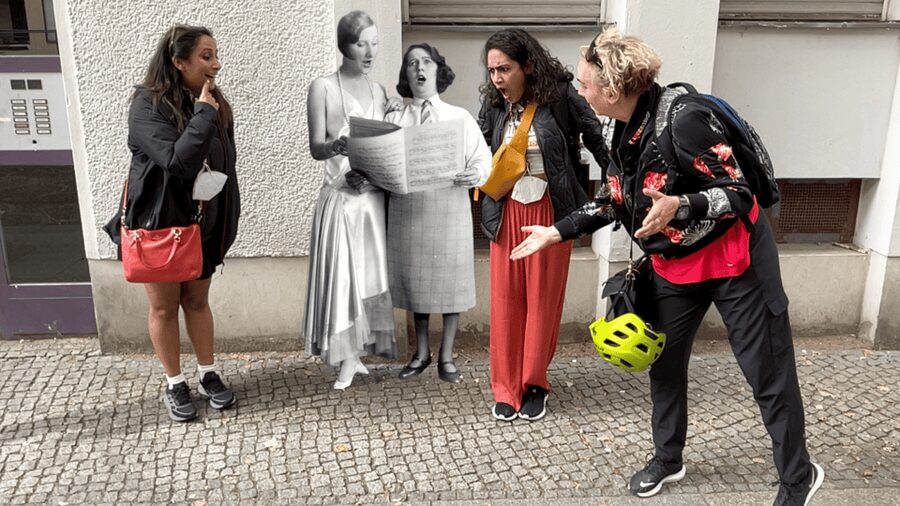
Berlin tells its queer story in plain sight. This 3.5-hour walk uses iPad AR to show archival photos exactly where events happened, and it’s led by Jeff, a queer activist and gender scholar. I also love the small-group size capped at 10, because it keeps the questions coming and the stories personal.
The main thing to keep in mind is the tour needs good weather, since most of it is outdoors and you will be on your feet.
Key highlights to know before you go
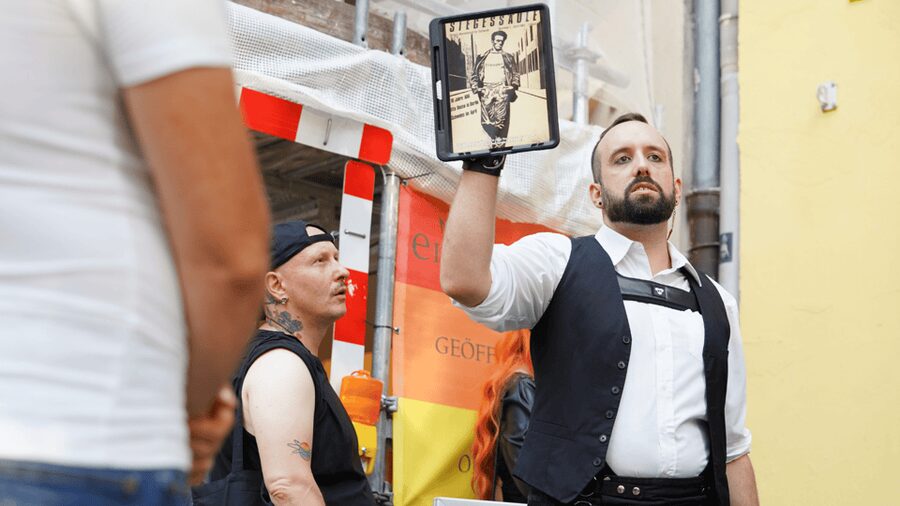
- iPad augmented reality at the street-level spots where history unfolded
- Mixies AR photos so you leave with fun, personalized keepsakes, not just memories
- 200+ archival photos, videos, and materials that help you remember what you saw
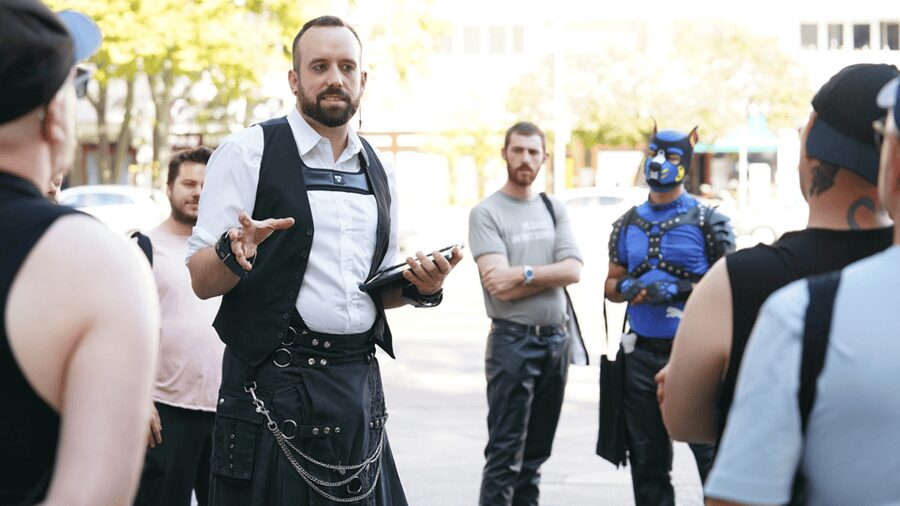
- A tight 10-person cap that makes a big difference for comfort and conversation
- A serious arc, from early queer activism through Nazi persecution, then post-war organizing, AIDS activism, and today’s nightlife
More Berlin ideas for the space still left in the itinerary
- Berlin: Natural History Museum Entrance Ticket★ 4.6 · 3,382 reviews
- Berlin: World Heritage Cruise to Potsdam★ 4.5 · 1,435 reviews
- Berlin Historical Highlights Walking Tour★ 4.9 · 657 reviews
- Berlin Private Complete History All Day Walking Tour★ 5.0 · 474 reviews
Why this Berlin queer and trans walking tour feels different
Berlin has signs, memorials, and museums. But what you really want on a topic like LGBTQ+ and trans history is connection: people, decisions, risk, and resistance, placed back onto the streets where it happened.
That is what this tour does well. It starts with early activism tied to Karl-Heinrich-Ulrichs, then moves through Nazi-era persecution and forced symbols like the pink triangle. From there, it shifts to everyday queer life in the 1920s, then follows the story into post-war groups and trans-led nightlife. You end in the present, looking at pride culture and the fight for an affordable city.
It also makes space for the emotional weight. Some stops are moving because they talk about survival, loss, and fear. Yet the pacing keeps you from feeling crushed, with humor and human scale woven into the facts.
Price and what you actually get for $83.13
At $83.13 per person for about 3 hours 30 minutes, this is not the cheapest walking tour. But the value is strong if you care about content, not just motion.
Here is what you get that most free tours do not include:
- An iPad AR experience provided for you, so you can line up old images with today’s street view
- Mixies AR photos for lasting group memories
- 200+ rare archival items, including photos and videos, built into the tour experience
- A guided walk led by Jeff, a queer activist and gender scholar, with a clear focus on LGBTQ+ and trans history
Small group time matters too. When you cap the group at 10, the guide can actually adjust for questions and interest. That is part of the reason reviews rate it a near-perfect score.
If you want a quick checklist: you are paying for context, visual proof on-site, and a guide who brings names and relationships into focus.
Meeting in Charlottenburg-adjacent Berlin, ending at Metropol
The tour starts at Alnatura Super Natur Markt, Else-Lasker-Schüler-Straße 18, 10783 Berlin, with a 2:00 pm start time. It ends at Metropol, Nollendorfpl. 5, 10777 Berlin.
You’ll appreciate the route because it does not feel like random hopping. The walk moves through a corridor of queer and trans landmarks around Nollendorfplatz and nearby streets, then pushes you toward the nightlife area. That means you finish where Berlin queer culture still shows up in venues and public events.
Because it runs in English, you can follow comfortably without switching languages or decoding German-only signage. It also uses a mobile ticket, and the meeting points are near public transportation, so getting there is usually straightforward.
Two practical notes:
- Wear comfy shoes. The stop times add up, and you will cover real ground.
- Plan your break slot. Coffee or tea isn’t included, though the tour notes suggest you might visit a café to pause.
Stop 1: Karl-Heinrich-Ulrichs-Straße, the push for decriminalization
You begin at Karl-Heinrich-Ulrichs-Straße 1. The focus here is Karl Heinrich Ulrichs, often described as the world’s first gay rights activist. The key takeaway is that queer identity and advocacy existed long before modern terms. Ulrichs publicly argued for decriminalizing homosexuality, laying groundwork that influenced later LGBTQIA+ movements.
This stop sets the tone. Instead of starting with tragedy, it starts with voice. You’re reminded that people fought for recognition early, even when society punished them.
What to watch for here is the street itself as a symbol. The fact that a Berlin street carries his name helps you understand how memory can become law, activism, and public acknowledgement over time.
Stop length is short, about 5 minutes, but it works as a foundation before the heavier parts begin.
- Berlin: Reichstag, Dome and Government District Guided Tour
★ 4.7 · 18,288 reviews - Berlin: 1-Hour City Tour by Boat with Guaranteed Seating
★ 4.3 · 16,993 reviews - Berlin: Boat Tour Along the River Spree
★ 4.4 · 11,252 reviews - Discover Berlin Half-Day Walking Tour
★ 5.0 · 9,624 reviews - Berlin: Hop-on Hop-off Bus Tour with Live Commentary
★ 4.3 · 8,579 reviews
Stop 2: Nollendorfplatz, Nazi persecution and the pink triangle
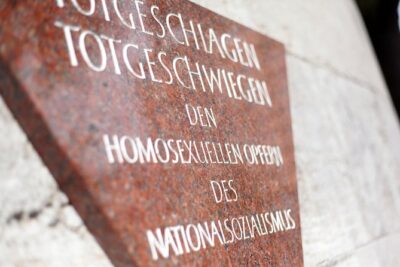
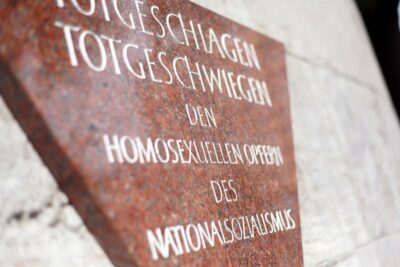
At Nollendorfplatz, the tour turns to the darkest chapter in the city’s LGBTQIA+ story: persecution under Nazi rule.
This stop covers multiple layers:
- Adolf Brand and right-wing gay activists, including how politics inside the queer world tangled with the rise of Nazism
- Ernst Röhm’s complex position, including how openly gay Nazis were folded into a regime that later targeted queer people
- Hitler’s stance on homosexuality and how that fed mass persecution
- The Night of the Long Knives, tied here to executions including queer people connected to or within the Nazi party
You also get the concentration camp reality: people were forced to wear the pink triangle. The tour balances historical facts with a reminder that resilience and resistance still happened, even under extreme control.
This is one of the emotional stops. If you need a moment, give yourself one. The tour allocates about 20 minutes here, long enough for the guide to slow down and help you process.
Stop 3: Schwerinstraße 13 and the sound of lesbian Berlin
Next is Schwerinstraße 13, focused on lesbian life in 1920s Berlin. This part matters because it corrects a common gap in many city histories. Gay male stories often dominate the narrative. Here, lesbian community gets attention as a real social world with venues, culture, and safety.
You visit the site of Toppkeller, a famous lesbian bar, and you explore how spaces like this let queer women build community. That is the practical meaning behind “history in the streets.” The city’s geography includes places where people could breathe.
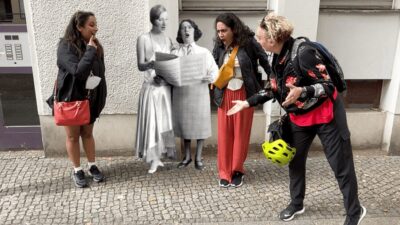
The tour also connects culture to resistance. You learn about Claire Waldoff, a lesbian cabaret singer whose songs became defiant anthems. You also hear about Josephine Baker, described as bisexual in the tour framing, who became a sex symbol for all genders.
Stop time here is about 20 minutes, and it usually feels like a shift in energy: less about terror, more about identity and art.
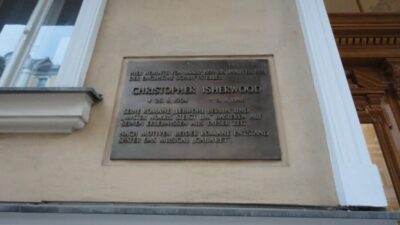
Stop 4: Nollendorfstraße 17 and Christopher Isherwood’s Berlin
At Nollendorfstraße 17, the tour brings in two surprises: the existence of a homosexual department within the Berlin police force, and the queer male life of 1920s Berlin that fed the creative imagination of outsiders.
This stop highlights Christopher Isherwood, whose experiences in Berlin inspired the later cabaret story that became famous through the musical and film. You also hear about his relationship with Heinz Neddermeyer, and how they escaped Nazi Germany as queer refugees.
Why I like this stop for planning your own understanding is simple: it shows that surveillance and art existed side by side. Police categories were a tool of control, while writers turned real people and real nights into art that could reach wider audiences.
Again, it’s about 20 minutes, so it is detailed without dragging.
Stop 5: Magnus-Apotheke and Magnus Hirschfeld’s Institute for Sexual Science
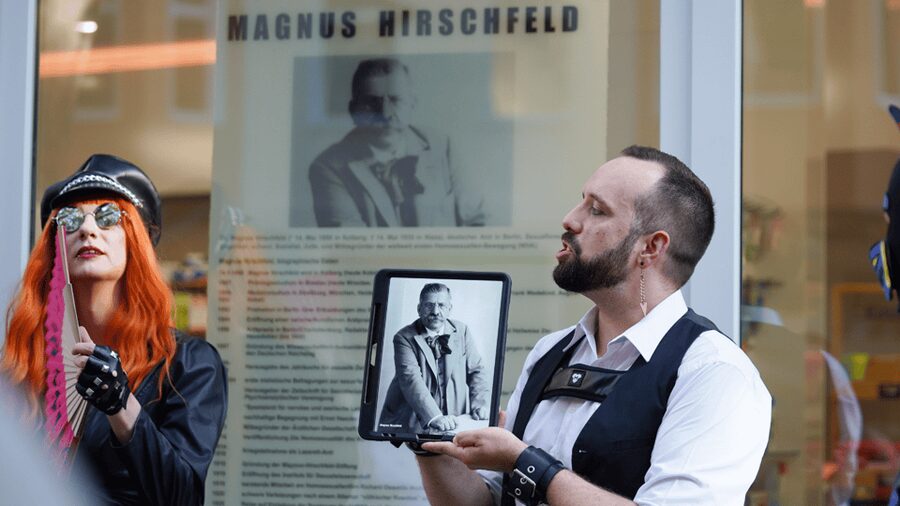
Magnus-Apotheke is one of the most important stops on the whole tour. Here, you learn about Magnus Hirschfeld, a major figure in LGBTQIA+ activism and gender research.
You get several core ideas in one place:
- The Institute for Sexual Science
- The Scientific-Humanitarian Committee, described as the world’s first organization dedicated to queer rights and gender studies
- Hirschfeld’s theories on sexual intermediaries and the idea of Berlin’s third gender
- The tour’s discussion of world-first gender-affirming surgeries performed on people including Dora Richter, Lili Elbe, and Karl M. Baer
Then it turns to law and violence. The fight against Paragraph 175, which criminalized homosexuality, is part of the picture. And you also get the devastating reality of how the Nazis destroyed the Institute, taking away a whole structure of documentation and support.
This stop is about 20 minutes, and it can feel like a study session without feeling like homework. AR visual elements help you see what you are learning in the actual surroundings.
Stop 6: Eldorado at Denns BioMarkt, drag history with a complicated shadow
At Denns BioMarkt (the former site of Eldorado), the tour shifts to nightlife, gender nonconformity, and the paradoxes of history.
Eldorado is described as one of Berlin’s famous 1920s drag bars, a hotspot for queer performers and gender-nonconforming people. You also hear a tricky detail: the tour notes that Ernst Röhm frequented the club, even though the Nazi regime later persecuted LGBTQIA+ people.
That contradiction can feel uncomfortable, but it is also part of what makes Berlin history worth learning. People, regimes, and social spaces did not move in straight lines.
Stop time is about 20 minutes. You will likely leave this stop thinking about how nightlife can be both sanctuary and a stage where power can reach in.
Stop 7: Prinz Eisenherz, post-war organizing and Charlotte von Mahlsdorf
Prinz Eisenherz becomes a checkpoint for post-war queer activism.
Here you explore early post-WWII organizing, including Homosexuelle Aktion West-Berlin, described as one of the first queer rights organizations after the war. The tour also covers the founding of SchwuZ, a Berlin queer club that became a landmark.
Then you get a trans-centered story: Charlotte von Mahlsdorf, a trans woman credited with preserving Berlin’s queer history and creating safe spaces in East Berlin.
This stop is about 15 minutes, which is just enough to connect the dots between activism, community institutions, and preservation. Charlotte’s role is especially important because it reframes history as something you build and protect, not just something you inherit.
Stop 8: Trans-led nightlife at the Chez Romy Haag connection
The tour’s trans community focus continues at the next stop, Connection, where the emphasis is on West Berlin’s trans scene in the 1970s and 1980s.
You hear about Chez Romy Haag, described as a legendary trans-led nightclub that helped revolutionize Berlin nightlife. The key idea you take away is how specific venues made gender-diverse people able to exist openly, without constant negotiation or concealment.
And then the tour links that to the club culture you see later in Berlin. It is not just nostalgia. It is a line of influence: early trans-led spaces helped shape the kind of nightlife where Berlin became internationally known.
Stop time is around 15 minutes.
Stop 9: Internationale Stele GEGEN DAS VERGESSEN, AIDS crisis and a divided city
At Internationale Stele GEGEN DAS VERGESSEN, the tour examines the AIDS crisis in Berlin and how it played out differently across the divided city.
You learn how queer communities organized to survive. You also get a specific name: Rita Süssmuth, described as one of the few politicians who advocated for AIDS awareness.
One of the most memorable framing moments is the metaphor the tour uses for the Berlin Wall, called the condom of the GDR, highlighting stark differences in how East and West Berlin handled the crisis.
This stop is about 20 minutes. Expect it to feel heavier than the nightlife stops. It’s also one of the best places to understand that activism is not only about protests. Sometimes it is about information, care, and getting people through a crisis that society would rather ignore.
Stop 10: Metropol, pride culture, techno roots, and gentrification resistance
You end at Metropol, where the tour connects queer nightlife of earlier decades to the city’s present-day scene and public events.
This last stop covers:
- Metropol’s role in the early gay community and techno scene
- The way it connects to today’s famous club names including Berghain and Lab.Oratory
- SO36’s legendary queer nights
- Folsom Europe, described as Europe’s biggest fetish festival
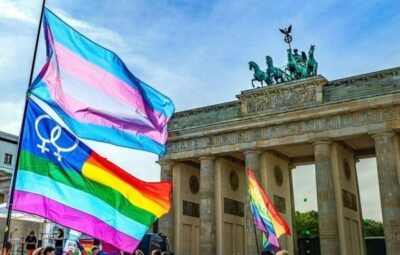
- Kreuzberg Pride and the Dyke March
- The ongoing fight for an affordable city, including the radical Tuntenhaus squat
Stop time is about 15 minutes, but it works as a launchpad. After you learn the earlier chapters, you start noticing that nightlife is not just entertainment. It is community infrastructure and, at times, political pressure.
If you want to keep the momentum, make a note of any event names you hear. Many of these are recurring and you can plan your later days around them.
What Jeff’s guiding style adds to the experience
The strongest praise for this tour is not just the topics. It is the way Jeff guides them: engaging delivery, a sense of humor, and a way of mixing fascination with moments that actually land emotionally.
You also get practical storytelling tools. The AR experience is a big part of why the tour sticks. Instead of seeing a photo later in your own research, you see it in the exact spot where it matters, with the guide helping connect the scene to the people involved.
And then there are the photos. The tour includes Mixies, which take personalized AR photos for you to remember the day in a way that is more fun than a plain group snapshot.
With a maximum of 10 people, the guide can talk at a human pace. That small size also means you are less likely to feel lost when questions pop up.
Who should book, and who might want to skip
This tour is a great fit if you want:
- LGBTQ+ and trans history that stays grounded in real street locations
- An AR-supported learning style, with archival images and quick reference materials
- A guided format that balances difficult chapters with community and culture
You might consider skipping if:
- You hate walking and prefer lots of indoor museum time
- You are looking only for a light, party-focused pub crawl (this tour starts serious and stays connected to activism)
Also, it runs in English, so it is easiest if that works for you. Most travelers can participate, and service animals are allowed, but the tour does require good weather.
Should you book this Berlin queer and trans history tour
I think you should book it if you care about Berlin beyond the usual postcard route. The combination of iPad AR, 200+ archival materials, and a guide like Jeff who brings names and human stakes into focus makes this worth the $83.13.
You are trading a bit of casual flexibility for real context. In return, you get a walk that moves from early activism to persecution, then into community spaces, post-war organizing, AIDS crisis response, and today’s nightlife and pride energy, ending right at Metropol.
If you’re short on time in Berlin and want one well-structured tour that connects the past to what you see now, this is a strong choice.
FAQ
How long is the Berlin Queer and Trans History Tour?
It lasts about 3 hours 30 minutes.
What is the group size?
The tour has a maximum of 10 travelers.
What language is the tour offered in?
It is offered in English.
What time does the tour start, and where does it end?
It starts at 2:00 pm at Alnatura Super Natur Markt, Else-Lasker-Schüler-Straße 18, 10783 Berlin. It ends at Metropol, Nollendorfpl. 5, 10777 Berlin.
What tech is included for the tour experience?
The tour provides an iPad for an augmented reality experience.
Do I need to buy admission tickets for the stops?
Admission tickets are listed as free for the stops.
Is the ticket mobile or paper?
You get a mobile ticket.
Do I need good weather?
Yes. The experience requires good weather, and if it is canceled due to poor weather you will be offered a different date or a full refund.
Is free cancellation available?
Yes, free cancellation is available up to 24 hours in advance for a full refund.
Is this tour family friendly or open to most travelers?
The info says most travelers can participate, and service animals are allowed.
More Historical Tours in Berlin




More Tours in Berlin
More Tour Reviews in Berlin
Recently added around Berlin

Berlin LGBTQ+ History Tours, compared.
 ★ 4.8Gay Berlin Out in Schöneberg Walking TourFrom $23281 reviews
 ★ 4.5Berlin’s Gay, Lesbian, and Queer Scene Small-Group Walking TourFrom $2466 reviews
 ★ 4.7Queer Berlin Walking TourFrom $2364 reviews
 ★ 4.9Street Art & Berlin Gay, Queer, Trans History + Free Gay MapFrom $5715 reviews
 ★ 5.0Queer Berlin Tour: Birthplace of LGBTQ+ MovementsFrom $1536 reviews
 ★ 4.9Where It All Began: Berlin’s Queer & Trans History TourFrom $816 reviews
Browse the lists this tour appears in